DHARMA PATHFINDER
Being Buddhist in India Today:
Seizing Mount Sumeru in the Latter Day of the Law
By Aspi Mistry
Myself when young did eagerly frequent
Doctor and Saint and heard great argument
About it and about: but evermore
Came out by the same door where in I went.
-Rubaiyat of Omar Khayyam
Entry into the Buddhist World through the door of suffering does not offer any guarantee of finding the exit marked “Nirvana”. I should know.
I was introduced to Buddhism in 1992, and it was through the Soka Gakkai, that I got my first taste of the Dharma. At that time I was facing charges of dacoity, theft of property, house-breaking and a host of other legal cases, all falsely filed against me. The intent was to get me and my family evicted from the house where we had been staying for some years.
Though we will always be grateful for the support and encouragement we received from our fellow-members in the Soka Gakkai during those difficult times, after a few years, my wife and I were slowly eased out of that organisation. Unfortunately, we had a tendency to ask too many questions and challenge their doctrinal errors and authoritarian manner of working.
I feel compelled to give some of these autobiographical details so that, you “dear reader” not only can understand better where I am coming from, but also by way of full disclosure about my own involvement in what I am about to reflect and comment on.
After we left the Soka Gakkai, I started the Dharma Rain Centre in Bombay in 2003. It was intended to be a non-sectarian centre where young people could come and discover the treasures of the Dharma, be free to ask any questions, and have intensive debates about almost any subject – something I had sorely missed during my years with Soka Gakkai.
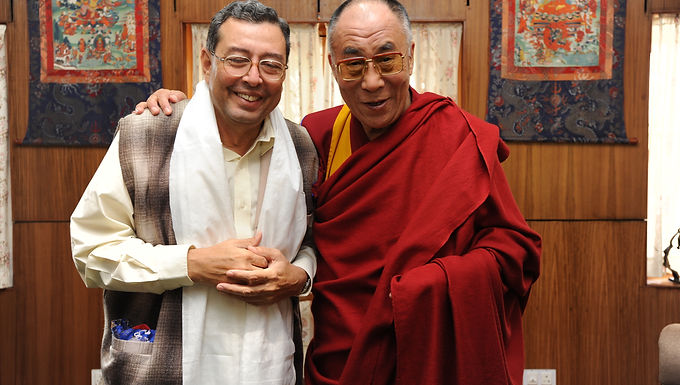
I got involved with organising teachings for His Holiness the Dalai Lama, and had the good fortune to meet various Buddhist teachers from almost all traditions of Buddhism. I was also involved in INEB (International Network of Engaged Buddhists), and in India with some of the organisations working with the followers of Dr Ambedkar.
Today, I also have the good fortune of being counted as one of the students of Dzongsar Khyentse Rinpoche.
When I reflect back on these last 25 years of being Buddhist in India, it strikes me as remarkable that I have been closely connected with all the three major markers of the Buddhist revival in India: the growth of Tibetan Buddhism with the arrival of His Holiness the Dalai Lama; the spread of the movement begun by Dr Ambedkar; and the rise of new buddhist groups and movements such as the Soka Gakkai.
And when one looks at the actual dates, we find that it was within a period of a little over five years, that these three significant events took place.
On 14th October 1956, when Dr Ambedkar converted to Buddhism along with 600,000 of his followers belonging to the untouchable castes, he was redeeming a pledge made in 1935 that though he had been born a Hindu, he would not die a Hindu.
In March 1959, the Dalai Lama set foot upon Indian soil as a refugee, and what the world had so far perceived as a trickle of Tibetan refugees, became a tidal wave that swept Tibetan Buddhism into India and the West.
In February 1961, Daisaku Ikeda, the third president of the Soka Gakkai, visited Bodh Gaya. During the visit, Ikeda and his party buried a copy of the Lotus Sutra and a plaque there on which he had inscribed a vow to help actualize the peace and prosperity of Asia. In the years that followed, he began to grow as a cult figure, Sensei to his ever-increasing number of followers in India.
Before I come to the two mainstream movements, namely Tibetan Buddhism and the Ambedkarite movement, a word or two about the Soka Gakkai. Regrettably, in a short feature such as this one, I cannot really do justice to the theme of Nichiren Buddhism in India and its initial establishment through the work of Nichidatsu Fujii during the freedom struggle for India’s independence. Or of Fujii-Guruji’s meetings with Mahatma Gandhi, Mahatma Gandhi chanting “Nam Myoho Renge Kyo” in his evening prayers, or the rise of the Soka Gakkai in the 21stcentury in the urban centres, especially Bombay and Delhi. So I shall reserve my comments and reflections on Soka Gakkai and my experiences in that organisation for another occasion, in another piece to be written perhaps in the next couple of months.
As a student and a political activist, I had always known the history of the mass conversion at Nagpur, under the leadership of Dr B. R. Ambedkar. But it was only when I came to know Dhammachari Lokamitra of the Trailokya Bauddha Mahasangha Sahayaka Gana (TBMSG) in Pune that I really understood both the immense impact of Dr Ambedkar’s legacy as well as the problems and workings of this movement.
At that time I had already met His Holiness the Dalai Lama and was beginning to organise the Dharma Rain Centre in Bombay. I soon realised that while in general there was an increasing interest in Buddhism in these urban centres, those who were attracted to His Holiness’ teachings as well as to the Dharma Rain meetings were mainly from an upper class and upper caste elite background. This was something I had experienced in the Soka Gakkai as well, where in fact it was explicit in their guidelines that persons from “Scheduled” castes and other Buddhist sects should not be brought into the organisation. (“Scheduled” here refers to the Schedule in the Indian Constitution which lists the lowest of the castes including the former untouchables, who are eligible for certain concessions and reservations as part of affirmative action).
Even now after twenty-five years, since I was first exposed to this situation, I can confidently state that this attitude of discrimination and viewing these communities as second class Buddhists, has kept Buddhism from growing and flourishing in India.
What is little known to most Indians is that Dr Ambedkar, who was the main impetus for this movement passed away on December 6th 1956, barely six weeks after the conversion ceremony at Nagpur leaving the masses of fresh converts and many hundreds of thousands that were to soon follow in his footsteps, without a leader or without any coherent leadership.
The main criticism levelled against this community of Buddhists, who now number over 10 million all over India (some say even 20 million depending upon their sources and the kind of reliance they place on the Indian census figures, considering that even the census enumerators many who are from the upper castes are often reluctant to record the correct number of Buddhists) is that the entire mass conversion phenomenon is just a political manoeuvre and has nothing to do with faith or religion.
The other major criticism used to bolster the first argument is that even when it comes to Buddhism, “these people” have an incomplete and distorted view of the Buddha’s teachings. And what is regularly quoted is Dr Ambedkar’s view that he does not believe in karma or rebirth, which he sees as views embraced by the Hindus to keep the lower castes in shackles over the centuries. It is true that some of these views have been expressed by him in his book “The Buddha and His Dhamma”, an effort by him to put all the myriad teachings of the Buddha in a simple one-book format.
It is astonishing that while this vast section of Indian Buddhists gets increasing worldwide attention from sanghas all around the world, and invoke nothing but admiration for their devotion to the Buddha and their teacher Babasaheb and their struggle to uplift themselves against the most inhuman odds, in India they are summarily dismissed as just a political formation.
In October, 1956 when six hundred thousand men and women, under the leadership of Dr Ambedkar decided to discard a millennium of degradation and poverty by embracing Buddhism, is it unreasonable to suggest that they perhaps had a faint hope that they would be able to improve their social status with this move? And even if such was the case, does it entitle us to reject and discard with such contempt the aspirations of millions of people, many now being the third generation from their grandparents who were the first converts?
In fact, there are movements led by religious nationalists and fundamentalists to prevent conversions.
And the state is very much complicit in discouraging religious conversions, certainly a violation of human rights and freedom of conscience. Laws exist, euphemistically called “Freedom of Religion Acts” that effectively ban conversions through the exercise of administrative power. Many of these laws require people who desire to convert to a different religion to provide the government with one month's notice, or face fines and penalties.
Though it may be argued that these laws are directed mainly against missionaries, it is often the potential converts who face humiliation and even rioting by fundamentalists at their doorstep.
As for the second criticism about the “purity” of the Buddha’s teachings, the followers of Dr Ambedkar are not the only Buddhists who reject “rebirth”. The tradition of Zen from which Ven. Thich Naht Hanh comes, also rejects the Tibetan Buddhist view of a mind stream separate from the body that continues from rebirth to rebirth. Yet we do not see upper class Indians distancing themselves from him or regarding him as one of the truly great Buddhist teachers of our times, which of course he truly is and highly respected by the Dalai Lama himself.
But beyond this divide in the Indian Buddhist world, those who follow Tibetan Buddhism or consider themselves as dakasand dakinis (I’m not joking!) are also not one homogeneous community. While all will of course be willing to call His Holiness their “teacher” at the drop of a hat, every group has its own Rinpoche or Vajradhara, often with an attitude of “My Teacher’s Bestest”.
As His Holiness the Dalai Lama has often said, “We need to be 21st Century Buddhists. Buddhist practice is to use our intelligence to the maximum to transform our emotions”
We have received teachings from the most precious and enlightened teachers of this tradition. Certainly we have much more to learn from them. The problem is neither with the tenets nor the dharma teachings. As my teacher, Dzongsar Khyentse Rinpoche says, “The issue is not the tea, but the tea cup”.
“The dharma teachings are like tea, while all other means to actualize these truths—practices, rituals, traditions, and cultural trappings are like a cup”
While His Holiness urges us to use our intelligence to the maximum, many of us have never developed, and some have lost the faculty of critical thinking and discernment. I have found that sometimes those who practice mindfulness the most, are often the most mindless in their interactions in the real world. Certainly the fault lies not in the practice, but in the practitioner.
And that brings me to a question that has recently been bothering me quite a lot.
The Vajrayana path of course hinges around the Guru and guru-devotion. Because of a new openness about vajryanapractices, scores of students receive initiations these days.
Will guru-devotion work in India? And how? With a caste-bound, hierarchical, patriarchal, authoritarian mind-set it is so easy to surrender to the “guru”. Forget about examining your guru’s qualifications and background as His Holiness so often advises, all critical thinking goes overboard.
The danger is on both sides. Gullible students being taken for a ride by fake gurus is of course an age-old story.
But perhaps in this post-truth, alt-fact world, the guru should also be very careful not to accept uncritically all that he learns from his “students”, “advisors”, from Facebook, from Twitter and social media. Sometimes the Dalai Lama too comes under severe criticism for statements innocently made by him. For instance, about the need for a woman Dalai Lama to be beautiful, if she were to succeed him. Politically incorrect. Or about refugees pouring into Europe, and the consequences for the future of Europe. Simply Incorrect.
Truly we are in the era of the Latter Day of the Law, or as the Japanese say the age of mappo. In the Lotus Sutra, the Buddha preaching about the difficulty of upholding the true Dharma in this age says:
“If you were to seize Mount Sumeru
and fling it far off
to the measureless Buddha lands,
that too would not be difficult.”
Right now I feel I have tried to seize Mount Sumeru and throw it over the horizon. Though my guru may admonish me more simply and gently, “Do not try to bite off more than you can chew!”
Note:This article was published on the Buddhist Door Global website on July 7, 2017: