DHARMA PATHFINDER


Once Upon a Time...
I was introduced to Buddhism in 1992, and it was through the Soka Gakkai, that I got my first taste of the Dharma.
At that time, I was facing charges of dacoity, theft of property, house-breaking and a host of other legal cases, all falsely filed against me. The intent was to get me and my family evicted from the house where we had been staying for some years. As a result, late on a Friday evening we found ourselves out on the street with just the clothes we were in, with our two sons still lugging their school bags. I was arrested that very night and my wife and the kids had to stay the night at my parents’ place, and moved next day to a friend’s home, as there was an arrest warrant out for my wife, and she have to remain out of sight until we could get anticipatory bail for her.
Three days later after the dust settled, and both of us had been given bail by the court, we moved to my younger brother Cyrus’ place. Financially we had been wiped out, and whatever little money we had would have seen us for just one more month of food and school fees.
At this point I was convinced that there was more to what we were going through, something that was beyond this material world and situation and I had to look for answers on some different plane. It was not just a simple case of “Why do bad things happen to good people?”
Searching for answers I began reading and re-reading scriptures and commentaries for I felt that perhaps I could find some pointers in the spiritual realm. So, I re-read the Bible, the Gita, even Zoroastrian theology, me being from a Zoroastrian Parsi family. It was then that my brother came up to me and said, if you are reading all this why don’t you read this too? And he gave me a book titled, “Introduction to Buddhism,” a book about the Buddhist practice he had been following for ten years or more at the time.
That day I sat up through the night, racing through the book as if I was reading a murder mystery or some best-seller. Finally, all the jigsaw pieces I was struggling to put together fell in place and I could see the big picture.
I became a closet chanter.
The Soka Gakkai
The Soka Gakkai (which means Value Creation Society in Japanese) or the BSG, the Bharat Soka Gakkai as it is known in India, is a branch of the Soka Gakkai International, SGI, headquartered in Japan. It has branches in most important towns and cities, and we were admitted into the district in Mumbai where my brother and his wife were members. The practice is based on the Lotus Sutra, a Mahayana sutra preached by the Buddha, and the primary practice is that of chanting the mantra that expresses obeisance and devotion to the Buddha of that sutra. As well as recitation of certain key sections of the Lotus Sutra. This practice was established and propagated by Nichiren Daishonin, a Japanese sage, some call him a bodhisattva, in 13th Century Japan. It is one of the main streams of what is often called the New Kamakura Buddhism.
We had many wonderful experiences and made many good friendships. We overcome our financial problems and got a house on rent within three months, as my software development business took wings again. But most important, we reached an out of court settlement with the person who had set this whole nightmare in motion. The criminal cases rambled on for nine years, till of course I was acquitted of all the false charges.
Through all those years we were very active members of the BSG, taking part in group activities and many creative presentations and discussions. Eventually, as I read more and more Buddhist texts and commentaries, I had a lot of questions regarding the doctrine of this particular Buddhist sect as well as some of its policies and guidelines that were enforced on the members. What rankled most was that we were not encouraged to read anything other than the organisations’ own publications, and an overall exclusivist approach with regard to all other faiths and even other Buddhist traditions, expressed as a superior attitude of “we represent True Buddhism, other streams being merely provisional.”
On balance, we will always be grateful for the support and encouragement we received from our fellow-members in the Soka Gakkai during those difficult times. We owe a debt of gratitude to all our leaders and kalyanamitras in the Soka Gakkai for bringing us to the Dharma. Though we are not with the organisation any more, we do continue the practice and if someone is interested, we are ready to teach them and encourage them in the practice.





His Holiness the Dalai Lama
Looking back now it feels strange that I did not recollect at that time the connection I had made so much earlier with Tibetan Buddhism. I had read “Seven Years in Tibet” when I was in school. I used to dream of meeting the Dalai Lama some day from the time I was in school. Odd as it sounds now, my first exposure to Tibetan Buddhism was through the books and novels of Lobsang Rampa that dealt with the author’s purported adventures in previous lifetimes as a lama in old Tibet. On lazy Sunday afternoons, a year or two after we friends had finished high school, we used to discuss and argue at length the nuances of this treasure-trove of knowledge we had discovered. I must confess, that for many nights I even tried astral traveling, but with not much success I am afraid.
Yet even before that there was a connection with Dharamsala and McLeod Ganj, where the Dalai Lama resides in exile. Our uncle and his family were the Nowrojees of the famous iconic shop at the entrance to this little town, where legend has it you could get anything from a pin to an elephant. They had owned and run the shop since the 19th century and it was my uncle, Mr. Nauzer Nowrojee who was one of the first inhabitants who met and welcomed His Holiness when he came to McLeod Ganj after his escape to India.
All these thoughts surfaced as one morning in 2002 I read in the Times of India that the Dalai Lama was in Bombay for a couple of days. At that time, I was closely involved with the Friends of Tibet, an organisation of Indian supporters campaigning for human rights in Tibet and to spread awareness of the Tibetan situation to the Indian public. As I sat down to do my practice that morning, chanting the mantra of the Lotus Sutra, I decided that I would chant very assiduously today to fulfil my wish to meet His Holiness somehow.
As I finished my chanting and was about to get up from my practice cushion, I received a phone call from my friend Tenzin Tsundue. “Hey Aspi” he said, “We are getting an audience with His Holiness tomorrow morning at the Leela Hotel. Would you like to come?” I couldn’t believe my ears.
Next day we were about 7 or 8 persons who met His Holiness at the hotel. I was able to tell him about my practice (without naming the SGI) and my problems and my habit of questioning the leaders. Was I guilty of causing a schism in the sangha, I asked. He laughed, “If you don’t ask questions, how will you learn?” He then said something very significant. “The practice you are doing is okay. You can continue to do it. When you are practicing you can stick to one practice, but when you are studying, study everything, all aspects, and all schools of Buddhism. Or you will become like this.” And he bent his head forward and put his hands on either side of his eyes to indicate a horse with blinkers.
I then asked him about my aspiration to start a dharma centre in Mumbai. His advice was, “Yes good. But make it more like a Youth Centre. Lots of youngsters and lots of debate. Do not make it like a monastery. We have many monasteries and big temple halls already!”
I left the audience with a renewed determination.
That was the beginning of the Dharma Rain Centre.
Dharma Rain Centre
At that time, as we were drifting away from the Soka Gakkai, a few like-minded friends and I started the Dharma Rain Centre in Bombay in 2003. It was intended to be a non-sectarian Buddhist resource centre where young people could come and discover the treasures of the Dharma, be free to ask any questions, and have intensive debates about almost any subject – something I had sorely missed during my years with the Soka Gakkai.
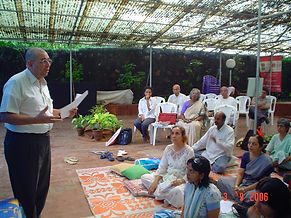
Due to the prohibitive costs of real estate in Mumbai and the difficulty of renting a suitable place, we never had a proper physical centre in Mumbai, but held weekly meetings at members’ homes every Saturday. I would present and we would have discussions on various Buddhist themes and concepts, sometimes studying texts, at other times invite teachers who may be passing through the city to hold sessions with us. We did this regularly for over 10 years.
Many great teachers during those years and even later up to the present day were kind enough to accept our invitations and give teachings. These were often public teachings open to everyone and organised in bigger halls and auditoriums. They included His Holiness the Dalai Lama, H.E. Dzongsar Khyentse Rinpoche, Jetsunma Tenzin Palmo, Geshe Lhakdor, Geshe Dorji Damdul, Ven. Sudhammacara, Dhammachari Lokamitra, Sulak Sivaraksa, and many others. We also went on residential retreats at centres outside Mumbai.
For a number of years, we organised Buddha Dharma Week where Geshe Lhakdor would come for nearly 7 to 10 days to the city and a series of events held, which included talks and teachings, film-screenings, 3-day retreats, and most importantly, visits to schools and colleges for free-flowing interactions with students.
Dharma Rain was also a key constituent of the Nalanda Shiksha Organising Committee, which was formed with the main objective of organising H.H. the Dalai Lama’s teachings for Indian audiences, including thousands from rural areas, across various centre all around India.
The 10th and last teaching in this 10-year cycle of teachings would hopefully be held in Mumbai towards the end of 2023.




The Triratna Buddhist Community
Around the time that Dharma Rain was being set up, and Dzongsar Khyentse Rinpoche and his student, and my good friend, Prashant Varma were planning the Deer Park Institute in Bir, Himachal, Prashant introduced me to Dhammachari Lokamitra, who was setting up the Manuski Centre in Pune.
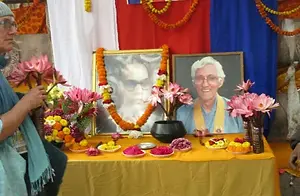
Born in London, UK, Lokamitra was ordained into the Western Buddhist Order (now known as the Triratna Buddhist Order) in 1974 by his teacher, Urgyen Sangharakshita. Since 1978 he has been living in India working mainly amongst the followers of Dr. B. R. Ambedkar. He initiated and for many years, developed the Buddhist and social activities of the Triratna Bauddha Mahasangha Sahayaka Gana (TBMSG), Bahujan Hitay Trusts and the Nagarjuna Training Institute in Nagpur.
For many years following my first meeting with Lokamitra I had the honour and privilege to be associated with the work of this community. The Manuski Centre was still under construction and the Jambudvipa Trust was operating from a rented premises across the street from the construction site.
During my numerous visits to Pune at that time, Lokamitra was kind enough to offer me his office as a bedroom, since there were no guest rooms then. The office had bookshelves stocked with the books written by his teacher Sangharakshita. Almost every night I would stay up beyond midnight devouring the teachings and life stories of Sangharakshita. His memoirs of his years in India and beyond, his setting up of the Friends of the Buddhist Order (FWBO) in England, and his various other writings, especially his masterly “Survey of Buddhism” which I still treasure and read to this day. That is why, I include him in my list of teachers though I was never able to meet him.
During my visits to Pune, and later Nagpur, I was involved in a variety of activities: workshops, teachings, conferences. I was always welcomed as one of the community. Lokamitra also inducted me for a three-year period onto the Governing Body of the Jambudvipa Trust.
My close involvement with the community of the followers of Dr. Ambedkar made me aware of the complete misconceptions that our caste-ridden society has about this community. You may see this reflected in some of my writings, especially “Being Buddhist in India Today.” Even now after over thirty years, since I was first exposed to this situation, I can confidently state that this attitude of discrimination and viewing these communities as second-class Buddhists, has kept Buddhism from growing and flourishing in India.
The Deer Park Institute
Today, I have the good fortune of being counted as one of the students of Dzongsar Khyentse Rinpoche and to be introduced as such.
I first met Rinpoche at a meeting set up by Prashant in the coffee-shop of a five-star hotel in New Delhi, along with Naresh Mathur, who later became such a good friend. (Very sadly, Naresh passed away during the Covid wave). At that meeting, I was trying to convince Rinpoche about the importance of setting up a centre like Dharma Rain in Bombay. I think Naresh and I also spoke about the situation of the Ambedkerite community, and their devotion to Buddhism.
Many years later when I requested Rinpoche to be my teacher his reply was, “Maybe.” But very soon after that he asked me to go and teach some of his students in Bhutan. I guess that was the time when in my mind “maybe” became “yes.”
Rinpoche set up the Deer Park Institute, a project of Siddhartha’s Intent Society in 2006. Since then, I have been attending teachings by him and other teachers at Deer Park. In 2010 or thereabouts I decided to take a house on rent in Bir so that I could spend more time in retreat and study. Over the next few years, I was increasingly involved in the activities of Deer Park and could help them in various aspects of their work including some administrative jobs, as well as communications, website development and legal trouble-shooting.
In 2016, we organised the first Siddhartha Festival in Bodh Gaya and in 2017 I was inducted onto the Board of Siddhartha’s Intent Society. I am still a Board member. But now I conduct regular teachings at Deer Park as well as other centres in Bangalore, Pune, Mumbai. I have attended and also represented Rinpoche, and presented papers at various International Conferences.
Since 2019 and up to very recently the Khyentse Foundation has been supporting me to not only teach and assist the Deer Park Institute but to do similar work and teach at various other centres and organisations.
During the pandemic, I was able to continue my teaching activities online and conducted over a 150 zoom sessions to date, and finished a verse-by-verse study of the Bodhicaryavatara (‘The Way of the Bodhisattva’) during this period.
Deer Park is also part of various other networks such as the Vikalp Sangam and Fireflies Dialogues on Climate Change, and I am equally involved there.
I was also involved in the INEB (International Network of Engaged Buddhists) Conferences. I was fortunate enough to spend many days with its founder Sulak Sivaraksa, traveling with him to Mumbai, the Bhaja Retreat Centre in Lonavala, and to Pune.
When I reflect back on these last 30 years of being Buddhist in India, it strikes me as remarkable that I have been closely connected with all the three major markers of the Buddhist revival in India: the growth of Tibetan Buddhism with the arrival of His Holiness the Dalai Lama; the spread of the movement begun by Dr. Ambedkar; and the rise of new buddhist groups and movements such as the Soka Gakkai.


