DHARMA PATHFINDER
Neglect of Buddhist Sites:
The Enigma of Indian Archaeology
By Aspi Mistry
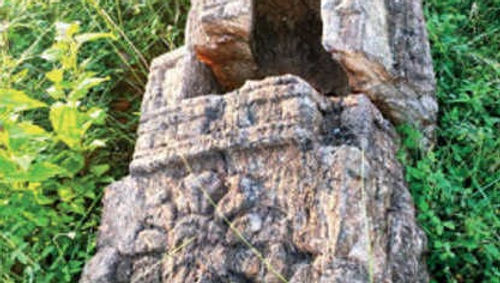
“Archaeology is like a jigsaw puzzle, except that you can't cheat and look at the box, and not all the pieces are there”. When Stephen Dean, Principal Archaeologist at Staffordshire County Council made that statement he could not have imagined that the Archaeological Survey of India (ASI) in a few decades since Independence, would manage to misplace 92 monuments, from different ages of Indian history. Of course, Stephen Dean was speaking about the detective work involved in actual archaeological projects. Yet the quote sounds equally apt when applied to the broken mosaic that is the ASI.
The figure of 92 “non-traceable” monuments is not a ball park figure, based on some back of the envelope calculations. It is a figure arrived at by the Comptroller and Auditor General of India, (CAG) the Supreme Audit Institution of India.
In a report titled “Performance Audit of Preservation and Conservation of Monuments and Antiquities of Union Government, Ministry of Culture [Report No 18 of 2013]” the CAG states, “The ASI informed (2006) the Ministry that 35 of the total centrally protected monuments were not traceable. This figure was also communicated to Parliament in the same year. The same information was also communicated again in June 2012. However, the joint physical inspection of the monuments along with the officials of the ASI revealed that in the sample of 1655 (45 per cent) monuments selected by us, 92 monuments (6 per cent) ….were not traceable” (CAG Report 18 of 2013, Page 14, para 2.5)
And further, “We observed poor documentation of the excavation works carried out by the ASI. The ASI HQ could not provide the status of 458 excavation proposals approved during the last five years. Similarly, complete information was not available on the status of pending excavation reports. We also noted numerous cases of excavation proposals not being undertaken or left incomplete”.
The CAG Report did not spare the Ministry of Culture either stating that, “We noted that the Ministry through the ASI had not conducted a comprehensive survey or review to identify monuments which were of national importance for inclusion in the list of centrally protected monuments.”( CAG Report 18 of 2013, Para 2.1). And further that, “Governance from the Ministry of Culture was lax and was found deficient on aspects of adequacy of policy and legislation, financial management, monitoring of conservation projects and provision of human resources to these organisations”. (CAG Report 18 of 2013, Para 11.1)
Many of the above facts have been highlighted numerous times by conservationists, activists, tourists, in blogs, newspaper articles, TV reports, petitions to the President of India and various other forums. Yet over the last 70 years since the country became independent, very little has been done to address the root problems or the structural deficiencies in the institutions that conduct archaeological research and conservation.
Considering this situation of overall mismanagement, at first sight the neglect of Buddhist sites seems to be just part of this whole quagmire. And yet if one views the numerous reports from journalists, conservationists, and Buddhist scholars, it does seem that one is justified in asking if there is something more significant when it comes to the apathy towards, and neglect of, Buddhist sites and monuments.
The web-based Archaeology News Network in 2013 reported on the work done by Siddhartha Gauri, founder of the Haryana-based forum which posted Right to Information (RTI) queries to culture and archaeology bodies across the country to find out about the work done by them on Buddhist sites.
“Incidentally, the response from Uttar Pradesh to the RTI query was the most surprising one, says Gauri. ‘The UP state archaeological department gave us the unbelievable answer that it has no Buddhist sites under its jurisdiction despite the state being the cradle of Buddhism. Bihar, another state richly dotted with Buddhist locations was no better. The RTI reply from the state archaeology department claimed that they have only three protected Buddhist sites under their jurisdiction,’ says Gauri. ‘However, we have collected information about at least 250 ancient Buddhist sites in the state, most of which are in a despicable condition. Even the Kesariya stupa in Motihari, believed to be the tallest Buddhist stupa in the world, doesn't have proper fencing. Animals are found grazing in its vicinity. Half of the stupa is still unexcavated while the other half which was excavated sometime back has started degrading rapidly.’” (Atul Sethi, Archaeology News Network)
Similarly, “The Hindu” newspaper in its edition of Jun 18, 2015 highlighted the neglect of sites in the state of Andhra Pradesh. “The rich cultural heritage of Bhavikonda, Thotlakonda and Pavuralakonda, dating back to the 3rd century BC and the ashes of the Buddha, found in a Mahasthupa at Bhavikonda, need to be protected…” the report states quoting G. Sambasiva Rao, former Chairman of the local chapter of the Confederation of Indian Industry (CII).
Nayanjot Lahiri is a professor of history at Ashoka University, and the author of books such as Marshalling the Past: Ancient India and its Modern Histories (2012) and Ashoka in Ancient India (2015). In her latest book, Monuments Matter: India’s Archeological Heritage Since Independence,Lahiri conducts a broad survey of the archaeological work that has taken place in India since 1947. (Surabhi Kanga, Caravan Magazine).
In an interview with the Caravan Magazine’s assistant editor Surabhi Kanga, she stated, “If it (the government) has one priority vis-à-vis archaeology, it should be to build it up as a science-based discipline in institutions of higher education. I think archaeology should be taken out of the corridors of the government and be given a much bigger place. From the corridors of political power to academic institutions and academic corridors, that’s where archaeology will flourish.”
Writing in the Huffington Post about “How India Is Squandering Its Top Export: The Buddha”, the well-known Buddhist teacher Dzongsar Khyentse Rinpoche says, “In India the blindness extends from the failure of India's educated elite to learn about, appreciate, and preserve their country's Buddhist heritage all the way to those who make a living selling Buddha's pictures and bodhi beads at pilgrimage sites, and to the fake monks and charlatans who score donations from unsuspecting Buddhist pilgrims…. “
“And it is manifest even at the most sacred Buddhist shrine in the world, the Mahabodhi Temple in Bodhgaya, where the Buddha became enlightened, which remains under majority Hindu management - a situation akin to having the Vatican or the Kaaba in Mecca run by a majority of Buddhists, or a Jewish congregation run by mostly Protestants.” (Dzongsar Khyentse Rinpoche, Huffington Post)
And it is perhaps here, in the age old dialectic between Hinduism and Buddhism and the tension between the cultural and religious, that we may find the root cause of the neglect of Buddhist sites.
Since the installation of the BJP (Bharatiya Janata Party) government in 2014, with Mr Narendra Modi as the Prime Minister, there has been a marked and aggressive push towards Buddhist diplomacy and an attempt to project India’s Buddhist heritage as the soft power variable, especially in the Indo-China and Asian equation.
“Though Modi's administration would like to stress that India's indulgence in Buddhism is not a religious exercise but a cultural one, the prime minister has in fact taken an audacious approach in linking Buddhism and Hinduism.” (Rishika Chauhan, ‘Modi and Buddhism: Between Cultural and Faith-Based Diplomacy’ - ORF Occasional Paper #77 November 2015)
But China too plays with the same Buddhist deck of cards. The report states, “China is actively portraying itself before the international community as a Buddhist nation. It is believed to be a strategy aimed at creating a common ground with the neighbours who are concerned about China's economic rise. One of the ways of communicating its Buddhist orientation has been by organising conferences and forums, including three World Buddhist Forums, in 2006, 2009 and 2012.
“India, for its part, hosted the Global Buddhist Congregation in New Delhi in November 2011 to mark the 2,600th anniversary of the Buddha's enlightenment. The event led to a diplomatic row between India and China as the latter objected to the Dalai Lama's participation. The disagreement finally resulted in China cancelling border talks with India, scheduled for the same month.” (ibid.)
It would appear that as long as Buddhism is viewed as a mere stream of Hinduism, a kind of protestant movement within Hinduism, and India’s Buddhist heritage is seen as a trump card to be played at the table of international diplomacy and foreign affairs, (we now also have the “Dalai Lama” card and the “Karmapa card), the preservation and conservation of Buddhist sites would be at the mercy of such considerations and calculations.
Selected Bibliography
Comptroller Auditor General of India, ‘Performance Audit of Preservation and Conservation of Monuments and Antiquities of Union Government, Ministry of Culture in CAG Report No 18 of 2013, Page 14, para 2.5 Page x para 11.1, <http://www.cag.gov.in/content/report-no-18-2013-performance-audit-preservation-and-conservation-monuments-and-antiquities#Chapter 5>
Atul Sethi, ‘Many Buddhist Sites In India Showing Signs Of Neglect’ in Archaeology News Network, Daily News/Sri Lanka, October 10, 2013, <https://archaeologynewsnetwork.blogspot.com/2013/10/many-buddhist-sites-in-india-showing.html#CxS6hOZm3uKqVKuA.99>
Surabhi Kanga, ‘Archaeology Should Be Taken Out Of The Corridors Of The Government: Historian Nayanjot Lahiri on the ASI and Preserving Indian Heritage’ in The Caravan Magazine, 14 August 2017, <http://www.caravanmagazine.in/vantage/historian-nayanjot-lahiri-asi-preserving-indian-heritage>
Dzongsar Khyentse Rinpoche, ‘How India Is Squandering Its Top Export: The Buddha’, Huffington Post 15/07/2016 < http://www.huffingtonpost.in/dzongsar-jamyang-khyentse/how-india-is-squandering-_b_7008922.html>
Rishika Chauhan, ‘Modi and Buddhism: Between Cultural and Faith-Based Diplomacy’ in ORF Occasional Paper #77, November 2015 <http://www.orfonline.org/research/modi-and-buddhism-between-cultural-and-faith-based-diplomacy/>
Note: This article was published in the Nov-Dec 2017 issue of Orientations. Orientations is a bimonthly print magazine published in Hong Kong and distributed worldwide since 1969. It is an authoritative source of information on the many and varied aspects of the arts of East and Southeast Asia, the Himalayas, the Indian subcontinent, and the Middle East, from the latest scholarly research to market analysis and current news and is an essential addition to any art library. Courtesy: https://www.orientations.com.hk/