DHARMA PATHFINDER
The Sutra of the Great Siddhartha Festival
As seen and imagined by Aspi Mistry
Thus have I heard :
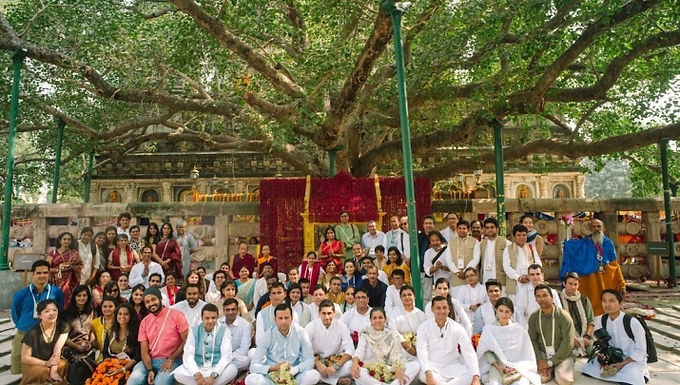
At one time, many centuries after the Buddha attained enlightenment, in the season of falling autumn leaves, a huge multitude of leading monks, nuns, laypersons and bystanders from the continent of Jambudvipa, now called India, gathered under the shade of the Bodhi tree, at the place of enlightenment, to celebrate the greatest Indian that ever lived.
It was the year 2559 of the Buddhist era, known in the western continents as 2016 CE, in the place called Bodh Gaya, in November.
And the heavens rained down a rain of flowers each day, a carpet of golden marigolds on the first, a pathway of white lilies on the second, and it was roses, red roses all the way on the third day of the festival of Siddhartha.
There were bodhisattvas and mahasattvas,dragon kings (and queens), kinnaras, gandharvas, dakinis and apsaras. And some senior officers of the state and students and professors and professionals.
But not all in the gathering could see these celestial beings. Nevertheless, all those in the great assembly, having seen what they had never seen before, were filled with joy, and pressing their palms together, gazed at the Buddha with a single mind.
The dear ones from Deer Park, the noble ones from the Vana community, those drenched with the Dharma Rain, those with a firm Foundation in the Khyentse lineage, the senior beings from Antara, the gandharvas and apsaras of the Pune sangha were all there as they made the eight auspicious offerings to the Tathagata in the traditional Indian manner.
Dzongsar Khyentse Rinpoche was there and in a voice clear and pure, issuing in soft and gentle sounds, he extolled the virtues of the Buddha.
After an offering to the Four Stages of the Buddha’s Life was made, Professor Mahesh Deokar gave an illuminating talk on the place of Enlightenment, Bodh Gaya and the gathering were amazed to hear such wondrous things they barely knew before.
This was the cue for the gandharvas and apsaras from Pune to guide the assembly led by Zubin Balsara into a group recital of devotional songs.
Namrata Mahabal and Jaydeep Vaidya took the assembly to celestial heights with their own Hindi rendition of Shantideva's dedication from the Bodhicaryavatara, ending with a soaring... "Manjugosh, manjushree, manjunath, manjugosh...” On the last high note many beings were seen having left their cushions, floating over the assembly, some with tears in their eyes.
There were animated conversations even during tea breaks, songs praising the Buddha’s achievements and prayers of aspiration, echoing the Buddha’s own aspiration when he encountered Buddha Dipamkara as a bodhisattva:
O Buddha, O Tathagata, O Mahamuni, Just as how you care, and how many you inspire.. How glorious and beautiful you are! May we also emulate and may we too actualize that ".
And on the first day as the shadows lengthened at sunset, and the lamps were lit, apsaras led by Maneesha Abhay, choreographed the auspicious eight offerings, mesmerizing the gathering with their rhythms and Kathak dance moves.
At the end of the first day, the entire assembly was transported effortlessly to the site of a great feast. And after the feast for the body, there was presented a feast for the mind and the heart.
Qawwali, Langa music, and Dzongsar Khyentse Rinpoche's latest film, "Hema! Hema!". And while we waited for that song in the bardo state, a brilliant performance of shadow puppetry by Vikramjeet Sinha.
The second day dawned with morning meditation led by Venerable Dhammadipa, followed by Dedication Chanting of 21 Taras led by Raji Ramanan.
After an offering to the Four Stages of the Buddha’s Life was made, Professor Mahesh Deokar gave an illuminating talk on the place of Enlightenment, Bodh Gaya and the gathering were amazed to hear such wondrous things they barely knew before.
More discussions over chai with Venerable Sumati, and a talk by Suresh Bauddha of the YBS on Buddha: India's Pride, was followed by Venerable Sumati's musings on the "Self-Forgetful, Imitative, Artificial" in Indian education, society and culture.
Then followed group sessions of storytelling, stories of the contributions made by great Indians to the spread of the Buddha Dharma - from Emperor Ashoka to Kumarajiva, the translator from Kashmir.
More vocal music by Vidya Rao segued into the dinner and post-dinner entertainment.
The third morning began once more with meditation and powerful Dedication Chanting of Samanthabhadra led by Deepa Thakur.
Asha Pillai-Balsara gave a scintillating account of the story of the Bodhi tree, a story entwined with the history of Buddhism itself. And as she came to the part describing the agonizing dilemma of King Ashoka wanting to cut a part of the tree, without hurting the tree, the Bodhi Tree over Asha's head very kindly dropped an overhanging branch at the feet of our gurus sitting in front. The beings in the great assembly smiled and bowed their heads, marvelling at this auspicious omen.
And in response to this gift from the universe, Annabelle von Arnim made her offering of two operatic arias, in a homage to Mother Nature.
After more gratitude was expressed to all beings and to the Buddhas of all directions, for this opportunity to celebrate this mighty son of Jambudvipa, this great assembly dispersed with promises to meet again.
Note: This “sutra” was published on The Buddhist Door Global (https://www.buddhistdoor.net/) on 6 January 2017:
https://www.buddhistdoor.net/features/the-sutra-of-the-great-siddhartha-festival/